Showing posts with label travel. Show all posts

City of Vicenza

Vicenza is one of the main cities in the region of the Veneto in the northeast of Italy.


You will find Vicenza along the main transportation line between Venice and Verona. The city is an easy train ride or bike ride away from a number of the largest and most famous Italian cities like Verona, Padua, and Venice. Vicenza is also about an hour away from Lago di Garda – Italy’s largest lake.

Great place to stop over during a bike tour or day trip from another location.  September and October are good bike riding months.  

For more information check out our site at https://www.italiaoutdoors.com/


10 Things that are not 'Italian' in Italy

1. Caesar Salad. This is American, not Italian. Asking for Parmesan and croutons on a salad would get you quizzical looks in most places. Some tourist trap restaurants will serve it. 

2. Rolling Spaghetti with a Spoon. Italians do not do this. You use a fork, that’s it.

3. Salad as Appetizer. Salads are a side dish with the second course. Having a salad as an appetizer is not common, Italians rather use it as a palate cleanser after eating the majority of their meal

4. Meat and Pasta on the same Plate. Italians do not put 2 courses on the same plate. Pasta is one thing - meat, chicken, meatballs are another: you will not see them mixed. Also, a good pasta dish doesn’t need to be drowned in sauce. Pasta is supposed to be colored by the sauce but not immersed in it.

5. Cappuccino after a Meal. Cappuccino is for breakfast. Past noon, Italians don’t drink cappuccino. So if you order it after a full meal, be prepared to get weird looks. Italians rather have a strong shot of espresso after a meal.

6. Oil and Butter with Bread in a Restaurant. Olive oil and butter are common ingredients in Italian dishes, but it’s not customary to eat them with bread during a meal. Restaurants will not put butter or olive oil on the table to dip bread in. Buttered or oil-drizzled bread might be afternoon snacks - requesting them at a restaurant would be weird.

7. Italians eat Pasta every day. Pasta is popular, but many Italians prefer rice or soup. The Italian diet is rich in vegetables, meat, and fish, which are present on the table every day. Pasta is more of a 2-3 times a week affair for many.

8. Italians eat big Dinners. In most cases, Italians eat more at lunch than at dinner.

9. Couples sitting side by side. Eating is a social event, so people prefer to be seated face to face. On a group outing or a double date a couple would rarely sit next to one another, allowing for more mingling.

10. Italians have large Families. Families with 4-8 children are a thing of the past. Italians not only get married later, they now also have one of the lowest birth rates in the world. As a result, the population is shrinking. Divorce is on the rise, and people often don’t start families until they’re well into their 30s. 

Rome is Opening New Doors

The Rome Palaces – Open Doors initiative launched at the start of November and includes visits to Medieval towers, gardens, villas and palaces.
“The idea is to share this enormous patrimony with Italian citizens and foreigners,” said Consuelo Lollobrigida, co-founder of the tour company Italian Cultural Tourism (Turismo Culturale Italiano). “Opening the doors of these places – some private, some public – is a form of respect and appreciation,” 
The buildings being opened up include those found on Via Giulia, named after 16th-century Pope Julius II who had a vision to beautify the city of Rome. A patron of renowned artists like Raphael and Michelangelo, he had grand plans to embellish the architecture of the city and the street that bears his name.
“People have a great curiosity in the historical and cultural assets of Rome and there is considerable interest,” said Lollobrigida. “Visits are always conducted with respect and discretion and limited to small numbers.”
One of the many buildings to see its doors opened to the public is Sacchetti Palace, built by Antonio da Sangallo in 1542. Once visited by popes and cardinals, the palace was bought by the Sacchetti family in 1649. Their descendants still live there today.
Tourists can also visit the loggia of the Knights of Rhodes which is built into the remains of the forum of Augustus in the Roman Forum, and Palazzo Chigi, official residence of the Italian prime minister.

Phone Usage on Vacation

phones and holidays can be a nightmare (iphone+holidays=holiday nightmare)


Even my friends will agree, as I tell them often enough, that I love my iphone.  But what I definitely don’t love is the shock of opening the bill when arriving home from Italy. I should know better – as I am aware that roaming charges are outrageous at around $7.00 a minute – and that is even if someone is calling you! But…there are always times when I have forgotten to turn my phone off and receive a call in the middle of the night, you know those calls…the local charity wanting to sell more raffle tickets. Even when I try to get them off the phone quickly, but politely, the call might have cost me $20 – ouch!

In addition to this, the iphone (and others) has a ‘fetch data’ function, which is great at home as all of your emails etc., are ‘pushed’ to your phone enabling you to check your mail in the coffee shop. This function overseas is a recipe for disaster – data charges can be huge.   Here are some great tips for avoiding a heart attack when opening your post holiday phone bill……


Do you really need to be available to all and sundry on holidays? If not, maybe you need an Italian sim card (or any other country’s card):

To use an Italian sim card:
  1. Make sure your phone is unblocked – before you leave for holidays ask your provider how this can be done, usually over the phone
  2. When in Italy buy a sim card at a phone dealer i.e., Wind, Tim – you will need your passport to verify your identity
  3. Insert your new sim card
  4. Text close friends and family, give them your new Italian number and let them know that they will be charged  international rates if they call
  5. You’re set.
If you need to be available on your own number, and want to keep using your phone, but  to avoid nasty surprises when you arrive home:
  1. Turn off 3G – this function allows your phone to work much faster allowing more data to download
  2. Turn off ‘Data Roaming’ – this will stop email etc., being sent to your phone (you can always check this at the hotel or an internet cafe)
  3. Use text to communicate with family and friends, this is much cheaper but still around $1.00 a text
  4. Use the hotel’s computer if you need to surf the web
  5. Of course, if you are in a wifi zone you will still be able to connect with the internet.
The way to turn off ‘Data Roaming” and ’3G’:
  • click ‘settings’
  • click ‘general’
  • click ‘network’
  • click ‘Enable 3G’ and ‘Data Roaming’ Put these in the Off position
  • You’re set

7 Tips for Traveling in Matera Italy

Matera, Italy: 7 Tips You Need to Know


Matera, a hauntingly beautiful town in Italy

Famous for its sassi and stunning landscapes, Matera, located on the border of Basilicata and Puglia, is one of our favorite cities in Italy. It’s not only breathtaking, but fascinating: Its history goes back more than 30,000 years.

And? It’s much easier to get to than people think.

Here are 7 things you need to know about Matera. Read on to find why you should add this scenic spot to your next Italy trip!

1. Matera’s famous sassi aren’t what you think they are


The sassi of Matera

Many people think that Matera’s cave dwellings are called “sassi.” They’re not. The sassi (literally meaning “stones”) actually refer to the two neighborhoods of stone dwellings in the ancient town.

Neolithic caves of Matera
Matera’s Neolithic caves

These dwellings, by the way, don’t always look like caves from the outside. (The caves you see in some pictures, like this one to the right, are Palaeolithic caves located across the ravine from Matera’s ancient center).

Instead, these dwellings, carved into the rock, look like homes piled one on top of the other. (Their interiors, though, often feel cave-like). It’s an ingenious, and space-saving, design: Step onto one of the narrow lanes between houses, and you’re actually standing on the roof of the house below. It’s also smart when it comes to sharing water, since water would be gathered on the plateau above the town and then come down so that the entire community could share it.

Two main quarters sprung up in Matera that were built this way… and these are the two sassi. 

2. Aside from Petra, Jordan, Matera is the oldest continuously-inhabited settlement in history


The Palaeolithic caves of Matera

We call the oldest period in human history the “Palaeolithic period,” a time when woolly mammoths roamed the earth and the last Ice Age was just winding down. And guess what? This is when people first settled in Matera. (We’re talking at around about 15,000 B.C.).

What makes Matera different from other Palaeolithic settlements, though, is that those inhabitants, and their ancestors, never left. Instead, they dug in—quite literally. In the Iron and Bronze Ages, newly-equipped with metal tools, settlers dug underground caverns, cisterns, and tombs in the landscape’s soft volcanic stone (called tufa). Famously, they also dug dwellings.

Those dwellings, and those people, remained throughout the later waves of rulers and empires, from Greeks to Romans to Byzantines. They (and their descendants) are still there today… even though some things are a little different.

3. Matera is where The Passion of the Christ was filmed

Because of Matera’s unearthly, ancient beauty, Mel Gibson chose it as the setting for his 2004 The Passion of the Christ. He’s not the first director to have set a Biblical film here: Pasolini’s The Gospel According to St. Matthew (1964), Beresford’s King David (1985), and Hardwicke’s The Nativity Story (2006) were all filmed here, as well.

4. In Matera, the living wasn’t always easy


Life in Matera’s stone dwellings: not always so romantic (photo courtesy of Casa Grotta di Vico Solitario)

Today, Matera seems incredibly romantic. But it wasn’t always this way. Even now, you can imagine the difficulties of living in the town’s ancient sassi: Homes, stores and churches are connected via narrow paths or stairs, so forget driving from your house to the grocery store. For those used to modern conveniences, living in a stone dwelling in Matera would be challenging!

In the 19th and early 20th centuries, poverty also was rife in Matera, as for so much of southern Italy. People lived in one-room stone homes—or, yes, caves—without heat or plumbing, often with donkeys or other animals sharing the same space. (For the curious, the Casa Grotta di Vico Solitario shows what living in the 1950s would have been like). Malaria was rife. Conditions were so bad that, in 1952, the government of Italy passed a law forcing Matera’s dwellers out of their old quarters and into new, modern buildings. This “new Matera” still exists, up the hill from the ancient sassi, and it’s where the vast majority of Matera’s residents live today.

But in 1993, the area was declared a UNESCO World Heritage site. And as Matera has gotten more popular, people have started moving back into the sassi, restoring the stone homes and even opening them as luxury hotels. If Matera’s 19th- and early-20th century inhabitants could see their town now, they’d be astonished!

5. Now’s the time to see Matera’s stone churches… but please, don’t touch the frescoes


The rupestrian church of Madonna di Idris in Matera

The churches of Matera, like the homes, are carved into stone. (These types of churches are called “rupestrian churches”). They date back to the Middle Ages; many have their interiors covered in vibrant frescoes.


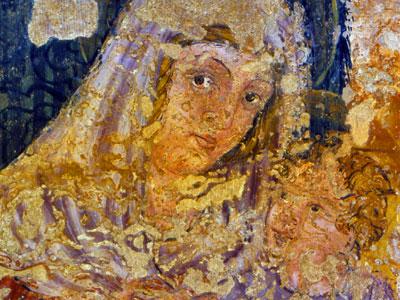
A damaged, but still vibrant, fresco in one of Matera’s rupestrian churches

Fascinating and eerie, these churches are also, unfortunately, in not-so-hot shape. While some restorations have taken place, the frescoes remain extremely delicate. And something that’s making them worse? Damage caused by tourists—particularly from touching them. (Frescoes are especially sensitive to moisture, so the natural oils from your skin damage the artwork). In one church after another, you can see where the frescoes have all but completely disappeared in the parts where people have grabbed onto them, such as around doorframes.

So please, go see the frescoes now, before they disappear. Contribute to their future restoration with your admission ticket price. And never, ever touch them.

6. If you don’t like stairs, you might not like Matera…


Coming to Matera? Expect to climb some stairs!

…or at least might not want to stay in its sassi. To get around, even just from your hotel to a church, you will be climbing stairs. Lots of them. And forget about handicap accessibility.

So bring your walking shoes, and prepare to work up a sweat… especially if you’re visiting in the summer. (Because this is Italy’s south, it can be relatively hot even through the end of September).
You have been warned!

7. Even though no train to Matera comes up on the Trenitalia website, you don’t need a car or bus to get there

This is something that even seasoned Italy travelers don’t realize: Matera is connected by train to Italy’s other towns!

Confusion comes in because if you go to the Trenitalia website and plug in, say, “Rome” to “Matera,” no solutions come up. But that’s not because there isn’t a train station here. (There is!). It’s because it’s not on the national rail system.

Instead, if you want to travel by train, the easiest way is to first get to Bari (which is connected to the national system, so you can look up times and prices on the Trenitalia site; it’s a 4-hour train ride from Rome to Bari). Then go to the regional train site, Ferrovie Appulo Lucane, putting in “Bari Centrale” as your starting point and “Matera Centrale” as your endpoint. A number of solutions pop up; the ride takes between 1 hour and 15 minutes and 1.5 hours, and the price is nominal (something like 2 euros). From the train station, it’s about a 15-minute walk to the sassi of Matera.

Note that the trains to Matera do not leave from the main part of the Bari Centrale station, but from a smaller station just outside the main one. When you walk outside onto the piazza outside the station, just look to your left, and you should see a building with the words ”Ferrovie Appulo Lucane.” That’s where you want to go.

Because this is a smaller train service, on holidays and Sundays, it might not run. In that case, there’s a bus from Bari to Matera; just ask at the station.

There are also buses to Matera from Rome, Ancona, Florence, and Milan—but in general, we’ve found the train is the fastest, cheapest way to get there.

Italian Airports


Italian Airports and Tips for Flying to Italy

bike tour italy, flying to italy
Italy has more than 130 airports throughout the entire peninsula and islands, services have gotten better and with the cost of gas and train tickets, there are several great options to connect your travel destinations by air. The two major direct international gateways in to Italy are Rome and Milan, and there are several other airports that serve as primary hubs for their regions many offering limited direct international connections.  Many of the smaller Regional airports can be reached by flying into an European hub first, this gives you many more options on ticket prices.
The list below is of the major airports in Italy, this is a working list so it is not 100% complete and there is constant change of services that I can not keep up with.   Depending on where you’re coming from and where you’re going in Italy, there may be a smaller regional airport that would also be a good option for you (you can often find these by looking at Google maps and zooming out a bit until you see an airplane icon, or by consulting the official website for the city you’re visiting).

Read more at McClure's Bike Italy